

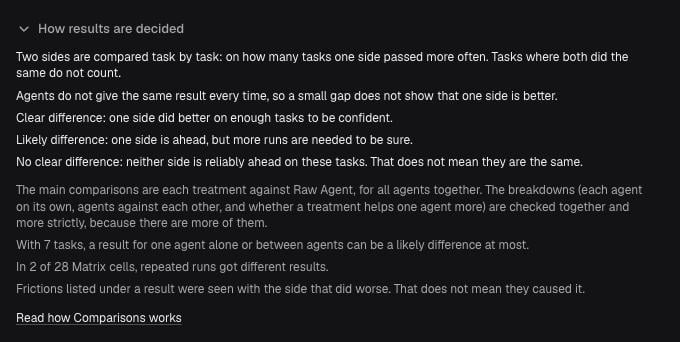
A difference requires at least 6 tasks where one side outperformed the other. With fewer differing tasks, no difference can appear regardless of how many trials you run.
Answers
Comparisons opens with a one-sentence headline answering your experiment’s main question, followed by one block per standout difference (up to 3 initially, with Show all N differences expanding up to 5 total Brief findings or any remaining blocks).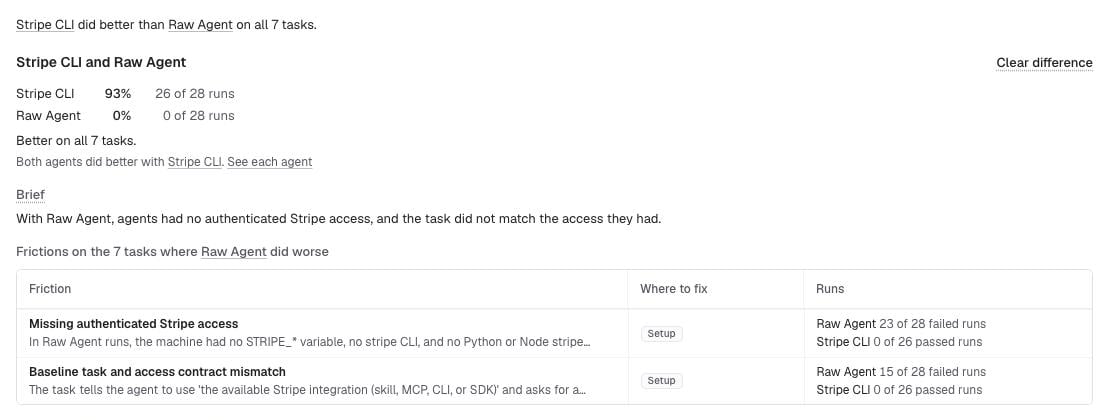
- “Stripe CLI did better than Raw Agent on all 7 tasks.”
- “Stripe MCP likely did better than Raw Agent on 6 tasks, same on 4.” (Likely differences are never stated as settled.)
- “No treatment did clearly better than All official CLIs across all agents.”
Brief
When Insights has reviewed the runs, up to 5 difference blocks include a Brief (the fourth and fifth appear after selecting Show all N differences). Each Brief pairs a one-sentence explanation from your Experiment insights model with up to 3 frictions observed on the tasks where that side did worse, showing counts for both sides (for example, “Raw Agent 24 of 28 failed runs”, “Stripe CLI 0 of 26 passed runs”). Select any friction to open its suggested fix. Frictions listed in a Brief were observed alongside the side that did worse—that does not prove they caused the difference.- After a fix: on a Clear difference that includes a product friction, After a fix, run the N tasks that differed again · N runs launches a focused follow-up experiment on just those differing tasks to verify your fix.
- What the runs did differently: with Insights in Agent mode (private beta), each Brief ends with paired examples comparing one failed run on the worse side against one passed run on the better side, highlighting the step where their paths diverged.
How Oqoqo builds the Brief
How Oqoqo builds the Brief
- Selection: Oqoqo counts runs with completed Insights reviews (excluding Oqoqo error runs) and lists a friction when it appears in at least 3 runs of the worse side across at least 2 tasks at a higher rate than the better side.
- Accuracy: Oqoqo computes all counts deterministically; the Experiment insights model writes only that one-sentence explanation (without custom instructions, rejecting any response that invents numbers or claims causality).
- Updates: the Brief regenerates whenever Evals or Insights finish (and once more in Insights Agent mode once all run pairs are analyzed).
Result labels
All comparisons
All N comparisons appears below the difference blocks and lists every comparison across four groups: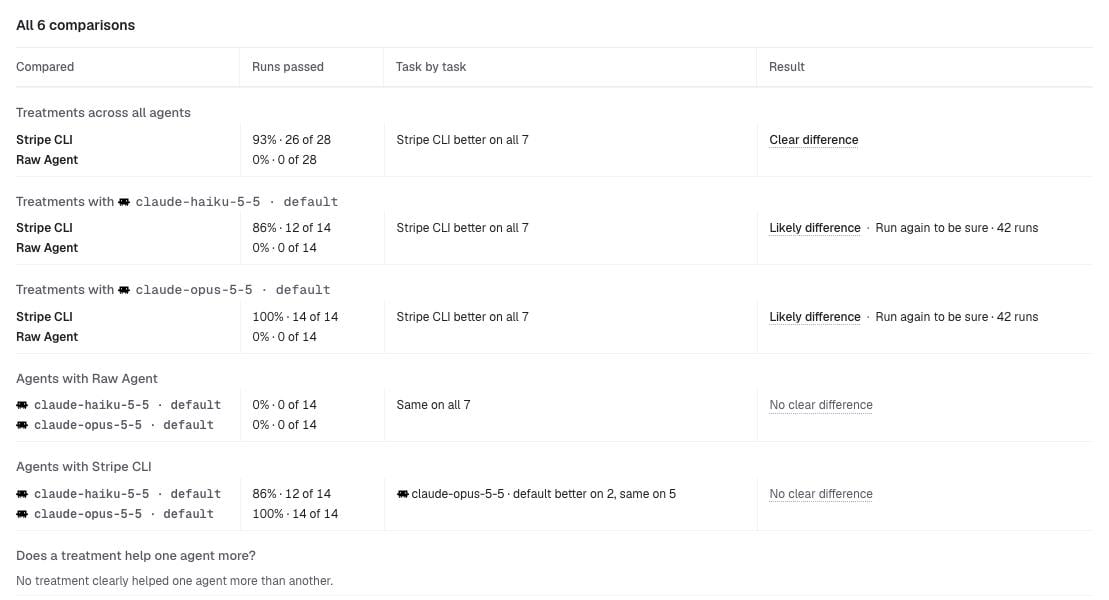
Run a comparison again to be sure
For a Likely difference, Oqoqo can plan a targeted follow-up experiment using the fewest extra trials (3 to 10 per combination) needed to settle the gap. This button appears on the latest Evals attempt of finished experiments whenever at least 6 tasks can still swing and 10 or fewer trials per combination suffice; otherwise it displays Needs more tasks to be sure.- Dashboard
- CLI
- Plugin (MCP)
Select Run again to be sure · N runs on the block or table row. Review the pre-filled New experiment run count and select Launch.If the comparison can no longer be run again, for example because Evals ran again or a treatment was deleted, the Matrix opens with Comparisons expanded and a note that explains why.
What the follow-up experiment includes
What the follow-up experiment includes
- Tasks: tasks from the original comparison that can still differ (minimum 6; tasks with at least 4 total runs that already passed or failed 100% on both sides are excluded).
- Sides: the comparison’s treatments and agents (all agents for cross-agent comparisons).
- Trials & settings: the minimum trials per combination (3 to 10), current treatment tools, original task versions, and the same Evals model and mode, named
"Run again: …".
Empty states
Public experiment links do not include Comparisons.
How results are decided
Expand How results are decided below All N comparisons to inspect the exact rules and constraints for your experiment.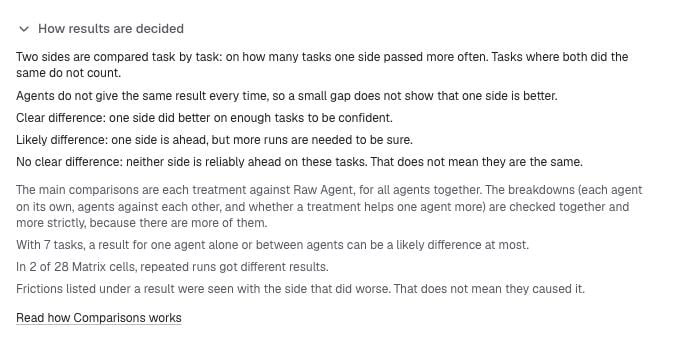
p = 0.063, whereas six give p = 0.031—which is why at least 6 differing tasks are required. Both sides compare the same number of scored runs per task and weight every agent equally, so Runs passed can be lower than total runs on Matrix.
Main comparisons and breakdowns
Testing many comparisons increases false positives, so Oqoqo applies the Holm correction separately within two groups:- Clear difference: adjusted
p < 0.05after correction within its group. - Likely difference: unadjusted
p < 0.05, but>= 0.05after correction. - No clear difference: unadjusted
p >= 0.05.
p = 0.016), the main comparison (corrected across 1 test) is a Clear difference (0.016 < 0.05), while each individual agent’s breakdown (corrected across 5 tests) is a Likely difference (5 × 0.016 = 0.078 >= 0.05).
From the CLI and the plugin
Next steps
Find and fix frictions
Fix the frictions flagged in the Brief and retest.
Measure a tool's impact
Verify that your tool’s lift holds up.
Compare agents and models
Compare agents and cost on settled differences.
Frictions
Explore every friction and its evidence.