> ## Documentation Index
> Fetch the complete documentation index at: https://docs.oqoqo.ai/llms.txt
> Use this file to discover all available pages before exploring further.
# MCP
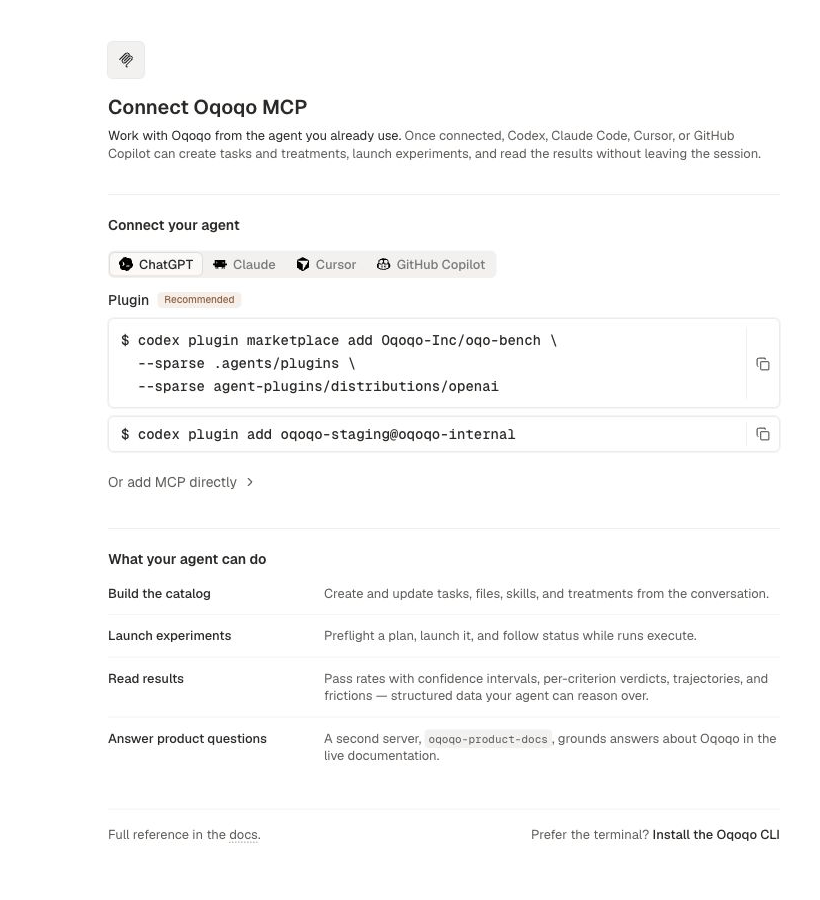
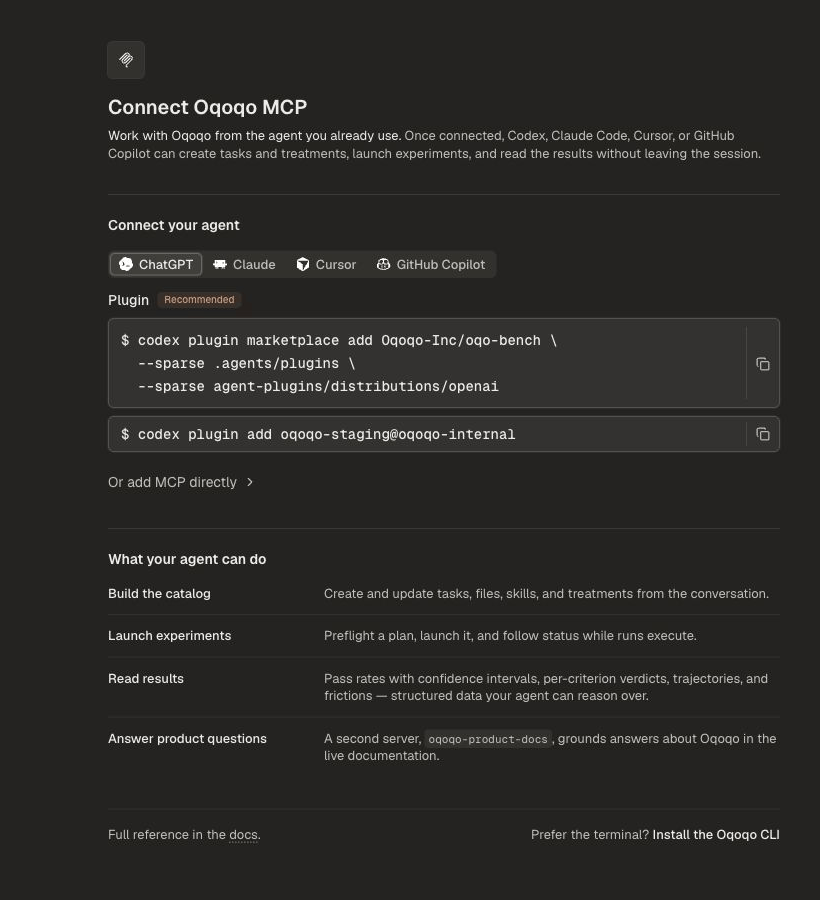
> Connect your coding agent to Oqoqo with the recommended plugin, or add MCP directly. Create tasks, launch experiments, and read results from the agent session.
Connect your coding agent to Oqoqo with the **plugin** (recommended). Then the agent can operate your workspace: create catalog items, launch experiments, watch runs, and read results.
The dashboard is for Matrix, Frictions, Traces, and for entering secrets. Day-to-day work can stay in the agent session.
This page is about the Oqoqo MCP server that operates your workspace. It is separate from MCP servers you attach to treatments when you test your own product. See [Treatments](/experiments/treatments) and [Assets](/experiments/assets).
## Why MCP exists
Your coding agent should be able to:
* create tasks and treatments with you
* launch and watch experiments
* read Matrix, traces, and frictions
* open the exact dashboard link when a secret is required
MCP gives that capability inside ChatGPT (Codex), Claude Code, Cursor, GitHub Copilot, and other MCP hosts. The [CLI](/operate/cli) exposes the same capabilities from the terminal. [Ask Oqo](/setup/ask-oqo) covers everyday work inside the dashboard.
You can also install from the dashboard under **Automate → Oqoqo MCP**.
## Install
Prefer the **plugin**. It registers the Oqoqo workspace server and the product docs server for you. Do not add both the plugin and a direct MCP connection in the same host. That would load the same tools twice.
### ChatGPT
```sh theme={null}
codex plugin marketplace add Oqoqo-Inc/agent-plugin \
--sparse .agents/plugins \
--sparse distributions/openai
codex plugin add oqoqo@oqoqo
```
### Claude
```sh theme={null}
claude plugin marketplace add Oqoqo-Inc/agent-plugin \
--scope user \
--sparse .claude-plugin distributions/claude-code
claude plugin install oqoqo@oqoqo --scope user
```
Then start Claude Code and run `/mcp`.
### Cursor
```sh theme={null}
cursor-agent plugin marketplace add https://github.com/Oqoqo-Inc/agent-plugin.git
cursor-agent
```
In Cursor Agent, enter `/plugin`. Open **Marketplace**, select **oqoqo**, and install it for the user.
### GitHub Copilot
```sh theme={null}
copilot plugin marketplace add Oqoqo-Inc/agent-plugin
copilot plugin install oqoqo@oqoqo
```
Then start `copilot` and run `/mcp auth oqoqo`.
Use this path only when your host does not support plugins. Authentication uses OAuth. On first use, the host opens Oqoqo's authorization page.
Workspace endpoint:
```text theme={null}
https://mcp.oqoqo.ai/mcp
```
Product docs endpoint (add once with direct MCP):
```text theme={null}
https://docs.oqoqo.ai/mcp
```
#### ChatGPT
```sh theme={null}
codex mcp add oqoqo --url https://mcp.oqoqo.ai/mcp
codex mcp login oqoqo
codex mcp add oqoqo-product-docs --url https://docs.oqoqo.ai/mcp
```
#### Claude
```sh theme={null}
claude mcp add --transport http --scope user oqoqo https://mcp.oqoqo.ai/mcp
claude mcp add --transport http --scope user oqoqo-product-docs https://docs.oqoqo.ai/mcp
```
Then start Claude Code and run `/mcp`.
#### Cursor
Add to `~/.cursor/mcp.json` (user) or `.cursor/mcp.json` (project):
```json theme={null}
{
"mcpServers": {
"oqoqo": {
"type": "http",
"url": "https://mcp.oqoqo.ai/mcp"
},
"oqoqo-product-docs": {
"type": "http",
"url": "https://docs.oqoqo.ai/mcp"
}
}
}
```
Then authenticate and enable:
```sh theme={null}
cursor-agent mcp login oqoqo
cursor-agent mcp enable oqoqo
```
#### GitHub Copilot
```sh theme={null}
copilot mcp add --transport http oqoqo https://mcp.oqoqo.ai/mcp
copilot mcp add --transport http oqoqo-product-docs https://docs.oqoqo.ai/mcp
```
Then start `copilot` and run `/mcp auth oqoqo`.
## Capabilities
MCP and the CLI share the same product capabilities.
 | Area | What you can do |
| ------------------------- | ------------------------------------------------------------------------------------------------------------------------------------------------------------------ |
| **Identity and projects** | Resolve identity, read project context, create/update/delete projects |
| **Catalog and resources** | Inspect catalog; author and manage tasks, files, machines, skills, MCP servers, CLIs, SDKs, treatments, and agents; apply, archive, and delete with impact preview |
| **Data** | Describe and query project data models |
| **Experiments** | Preflight, launch, list, get, clone plan, watch status, cancel |
| **Runs and results** | List runs, page trajectories, fetch transcripts, analyze results |
| **Evals and Insights** | Preview, trigger, list, and get eval and insight results |
| **Quota** | Inspect run balance and ledger; open billing when you need to buy more |
| **Notifications** | List, acknowledge, and manage notification preferences |
| **Project AI** | Inspect and manage project AI bindings; open Web links for credentials |
| **Setup links** | Open exact dashboard links for secure setup and MCP account auth |
Destructive tools use the host's native approval flow plus a short-lived server confirmation.
## Keep secrets in the dashboard
OAuth grants, API keys, and secret headers stay in the dashboard. Ordinary project, catalog, experiment, and analysis work stays available from the agent session. When a tool needs a secure value, it returns the exact Web setup link for that step. Billing checkout also stays on the Web.
## First prompt
```text theme={null}
Show my Oqoqo projects, list the current project's catalog, and summarize recent experiments.
```
Then ask the agent to draft a task, launch a small experiment, and explain the Matrix and frictions when it finishes.
## Related pages
The same capabilities from your terminal and scripts.
The in-app assistant for everyday project work.
Create and switch projects.
Where each surface lives in the app.
| Area | What you can do |
| ------------------------- | ------------------------------------------------------------------------------------------------------------------------------------------------------------------ |
| **Identity and projects** | Resolve identity, read project context, create/update/delete projects |
| **Catalog and resources** | Inspect catalog; author and manage tasks, files, machines, skills, MCP servers, CLIs, SDKs, treatments, and agents; apply, archive, and delete with impact preview |
| **Data** | Describe and query project data models |
| **Experiments** | Preflight, launch, list, get, clone plan, watch status, cancel |
| **Runs and results** | List runs, page trajectories, fetch transcripts, analyze results |
| **Evals and Insights** | Preview, trigger, list, and get eval and insight results |
| **Quota** | Inspect run balance and ledger; open billing when you need to buy more |
| **Notifications** | List, acknowledge, and manage notification preferences |
| **Project AI** | Inspect and manage project AI bindings; open Web links for credentials |
| **Setup links** | Open exact dashboard links for secure setup and MCP account auth |
Destructive tools use the host's native approval flow plus a short-lived server confirmation.
## Keep secrets in the dashboard
OAuth grants, API keys, and secret headers stay in the dashboard. Ordinary project, catalog, experiment, and analysis work stays available from the agent session. When a tool needs a secure value, it returns the exact Web setup link for that step. Billing checkout also stays on the Web.
## First prompt
```text theme={null}
Show my Oqoqo projects, list the current project's catalog, and summarize recent experiments.
```
Then ask the agent to draft a task, launch a small experiment, and explain the Matrix and frictions when it finishes.
## Related pages
The same capabilities from your terminal and scripts.
The in-app assistant for everyday project work.
Create and switch projects.
Where each surface lives in the app.